 ultimate-guide
How to Choose a Reliable Landscaper: 2026 Guide
Table of Contents
- Start With Your Project Goals and Scope
- Check Licensing, Insurance, and Local Credentials
- Review Landscaper References and Reviews Before You Call
- Key Questions to Ask a Landscaper During Your First Call
- How to Compare Landscaping Quotes and Estimates
- Your Landscaping Contract Checklist: What Must Be in Writing
- Red Flags That Signal an Unreliable Landscaper
- Conclusion: Making Your Final Decision
- Frequently Asked Questions
Last Updated: October 17, 2026
Start With Your Project Goals and Scope
Knowing how to choose a reliable landscaper starts with one step most homeowners skip: defining the job before you call anyone. A landscaper designs, installs, and maintains outdoor spaces, from lawn care and planting to patios, drainage, and tree work.
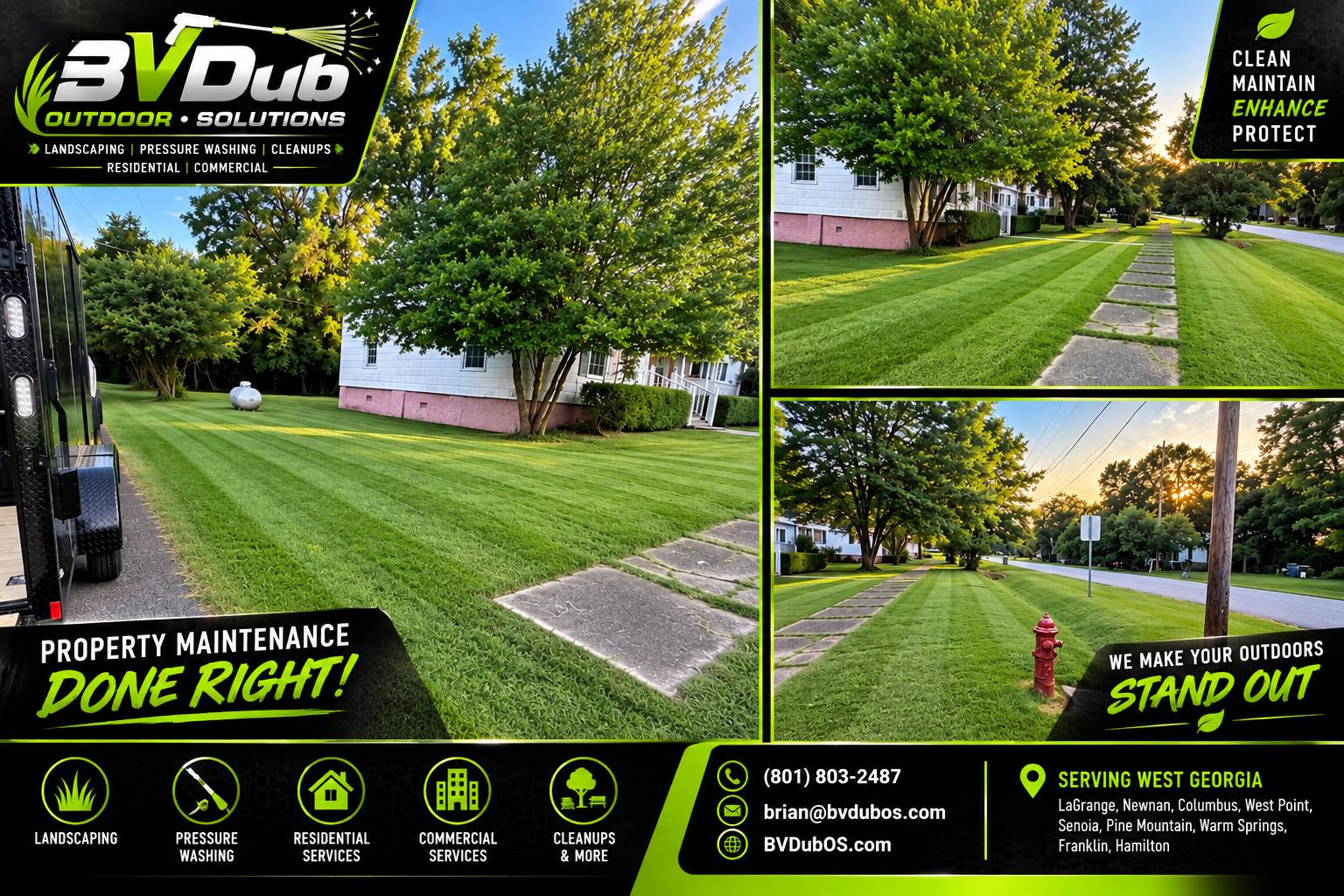
At BV Dub Outdoor Solutions, we work with homeowners across LaGrange, Woodland, Columbus, and Newnan, and the pattern is consistent. Vague briefs produce vague quotes. Specific briefs produce itemized ones you can compare.
Write down three things before you dial:
- The outcome you want: curb appeal before a sale, a usable patio, or a lawn that stops flooding
- The scope: design and installation, ongoing maintenance, or a one-time cleanup
- Your rough budget range: a number you can share, even if it is wide
That last point matters more than people expect. Without a stated range, every conversation becomes a fishing expedition, and you collect quotes describing different jobs at different quality levels.
Check Licensing, Insurance, and Local Credentials
Ask for proof of licensing and insurance before you discuss design ideas. A legitimate landscape contractor should produce a business license and certificate of insurance on request, without hesitation.
Here is the verification checklist we suggest to every homeowner:
- Business license number, verified through your state or local licensing authority
- General liability insurance, with the certificate sent directly by the insurer
- Workers' compensation coverage, especially if crews will be on your property
Call the insurer's number on the certificate rather than trusting a photocopy.
Local requirements vary by city and county, so check with your own municipality about permits for hardscaping, drainage work, or tree removal.
Review Landscaper References and Reviews Before You Call
References and reviews answer a different question than credentials do. Credentials tell you a company is allowed to work.
Treat online reviews as a starting point, not a verdict. Look for patterns rather than individual complaints: one billing-dispute review reads differently than five mentioning crews that stopped showing up mid-project.
Then do the part most homeowners skip: call two or three references from similar projects and ask specific questions.
- How long did the project actually take compared to the estimate?
- Did the crew show up when they said they would?
- Was the final invoice close to the original quote?
Ask for references from jobs completed at least a year ago.
Key Questions to Ask a Landscaper During Your First Call
The first call should take fifteen minutes and answer five things: scope, timeline, communication, warranty, and problem handling. If a company cannot answer these clearly on the phone, the written proposal will not be clearer.
Most guides give one list of questions for every project. That is the gap: the criteria for a weekly maintenance contract differ from those for a patio build or drainage redesign.
If You Are Hiring for Ongoing Maintenance
Maintenance is a route business. The company's economics depend on how many properties they service in a day, so the questions that matter are about consistency, not design flair.
- How many crews do you run, and who is on my property each visit? A company with one crew and fifty clients will rotate substitutes. Ask whether the same lead technician will be assigned to your property.
- What is your make-up visit policy when weather cancels a service? In Georgia, summer thunderstorms and winter freezes both wipe out scheduled days. A written make-up policy separates a real maintenance company from a mow-and-go operation.
- What is included in the base price versus billed as extra? Edging, blowing, bed weeding, shrub trimming, and seasonal cleanup are the usual add-ons. Get the inclusions list in writing before you compare prices.
- How do you handle plant health problems, disease, pests, fungus? A maintenance-only company may not carry the licensing to apply treatments and will refer you out. Ask who is accountable when a shrub dies.
- What is the cancellation notice period? Month-to-month with 30 days' notice is common. Annual contracts with auto-renewal and no exit clause are a warning sign.
If You Are Hiring for Design, Installation, or Hardscaping
Design and build is a project business, so the questions shift to scope control, sequencing, and change-order pricing.
- Who is my point of contact from contract to punch list? On a design-build project you want a named project manager, not a salesperson who hands you off after signing.
- What is the realistic timeline, including weather and material lead times? Natural stone, specific plant cultivars, and irrigation components can carry multi-week lead times. Ask the company to name the long-lead items in your project.
- What is not included? Haul-away, permits, irrigation repairs, tree protection, and lawn restoration are common exclusions. Ask directly: "What is on this job that would be billed as an extra?"
- How are change orders priced and approved? You want a written change-order process with unit pricing agreed before work starts, not a verbal "we'll figure it out."
- What happens if I am unhappy with the work? Get the answer in writing later, but listen for whether the company describes a specific remedy process or just reassures you.
The Question That Applies to Both
Ask: "Do you handle drainage, weeds, and pest issues, or do I need other companies?" A single point of accountability saves you from coordinating three crews. Note whether the answer is a clear yes, a clear no, or a vague attempt to keep talking.
How to Compare Landscaping Quotes and Estimates
Comparing landscaping quotes and estimates means comparing line items, not totals. Two bids for the same patio can differ by thousands because one excludes base preparation, drainage, or disposal.
Ask every company for the same itemized format:
| Line Item | What to Look For | Why It Matters |
|---|---|---|
| Materials | Specific types, quantities, and brands | Vague entries hide substitutions |
| Labor | Hours or crew size, not a lump sum | Reveals whether the bid is realistic |
| Site prep | Excavation, grading, disposal listed separately | Common hidden cost |
| Drainage | Included or excluded, stated clearly | Drives long-term problems |
| Permits | Who files and who pays | Avoids surprise fees |
| Timeline | Start and completion dates | Protects your schedule |
| Payment schedule | Deposit, milestones, final payment | Ties money to progress |
| Warranty | Coverage length and what it covers | Your only recourse after handoff |
An unusually low estimate is not a bargain.
Get at least three written quotes for the same scope, then compare line by line. If one number is dramatically lower, ask the company to walk you through it before you sign anything.
Your Landscaping Contract Checklist: What Must Be in Writing
A written contract protects both sides; a verbal agreement protects neither. Before work begins, confirm the document includes every one of these, and understand what each clause does for you.
- Full scope of work, in plain language, with materials specified. "Install patio" is not a scope. "Install 400 sq ft of 2-inch bluestone on compacted gravel base with polymeric joint sand" is. Vague scope language is the most common source of mid-project disputes.
- Total price and payment schedule tied to milestones, not calendar dates. "$2,000 on the 15th" pays for time. "$2,000 on completion of base prep" pays for work. Milestone-based payments keep your money and the project in step.
- Start date and estimated completion date. Include a stated allowance for weather delays, and ask what happens if the delay exceeds it.
The Deposit Rule
Watch the deposit. A large upfront payment with nothing scheduled is the most common setup for a bad outcome. A reasonable structure is a deposit covering materials ordered for your project, milestone payments as work completes, and a final payment held until you walk the job and sign off on the punch list. If a company wants most of the money before the first shovel hits the ground, ask why, and get the answer in writing.
Maintenance Contracts Need Two Extra Clauses
For ongoing maintenance agreements, the same rules apply, plus two extras:
- Cancellation terms. How much notice is required, and is there an auto-renewal? A contract that renews automatically without a reminder is a contract you will argue about next spring.
- Make-up visit clause. What happens if a scheduled visit is missed due to weather or crew availability? A maintenance contract without a make-up visit clause is a contract you will argue about in July.
What a Good Contract Does Not Do
A good contract does not lock you into a relationship you cannot exit or shift all risk to you. A one-page document with no warranty language and no dispute process is not a contract, it is an invoice waiting to happen. Ask for the standard agreement before signing, read it once for scope and once for money, and get any verbal promise added in writing before work begins.
Red Flags That Signal an Unreliable Landscaper
Some warning signs are obvious. Others only show up when you know what to look for. The Federal Trade Commission's consumer advice on hiring contractors recommends treating pressure tactics and upfront cash demands as serious warnings, and that guidance applies directly here.
Watch for these:
- Cash-only payment with no receipt. No paper trail means no recourse.
- Pressure to sign today for a discount. Legitimate companies let you think it over.
- No physical address or verifiable business history. Ask how long they have operated in your area.
One caveat: a single red flag does not always mean walk away. A small owner-operated company may have a simple contract and no glossy brochure. What matters is whether they answer questions directly and put commitments in writing.
Conclusion: Making Your Final Decision
The hardest part is not finding candidates but trusting one with your property after a string of disappointing experiences.
That is the standard we hold ourselves to at BV Dub Outdoor Solutions. Our team communicates directly and puts the scope, timeline, and warranty in writing before work begins.
Get started with BV Dub Outdoor Solutions and get a quote for your property.
Frequently Asked Questions
What should I check before hiring a landscaper?
Verify the company's business license, liability insurance, and workers' compensation coverage before signing anything. Ask for proof of insurance and call the insurer to confirm it is active. Check online reviews on Google and the Better Business Bureau. Request at least three local references from projects similar to yours and actually call them. A reliable landscaper will provide all of this without hesitation. If any request is met with excuses, move on to the next candidate.
How many landscaping quotes should I get?
Get at least three written estimates from licensed landscaping companies. This gives you enough data to spot pricing outliers. One quote is not enough because you have no benchmark. Two quotes make it hard to tell which is fair. Three or more lets you compare line items, labor rates, and material costs side by side. If one bid is dramatically lower than the others, ask what is excluded.
What should a landscaping contract include?
A solid landscaping contract lists the full scope of work, specific materials with quantities, a project timeline with start and completion dates, the total price and payment schedule, warranty terms, and a dispute resolution clause. It should also state who handles cleanup and debris removal. Never accept a verbal agreement or a one-page estimate as a contract. Review every line before signing, and ask about anything unclear. A reliable landscaper expects you to read it carefully.
What are the most common mistakes when choosing a landscaper?
The biggest mistakes are skipping the license and insurance check, accepting the lowest bid without reading the scope, and paying too much upfront. Many homeowners also fail to ask about warranties or get everything in writing. Another common error is hiring based on a single online review or a door-to-door pitch. Take time to verify credentials, compare at least three written quotes, and confirm the contract covers what you discussed. Rushing this process often leads to poor work and costly redo jobs.
How do I check if a landscaper is licensed and insured?
Ask the landscaper for their license number and a certificate of insurance showing general liability and workers' compensation coverage. Call the insurance company directly to confirm the policy is active and covers landscaping work. Check your state or local licensing board to verify the license is current and in good standing. If the company uses subcontractors, confirm they carry their own insurance too. Any legitimate landscaping contractor will provide these documents quickly and without pressure.